Search
To search for an exact match, type the word or phrase you want in quotation marks.
A*DESK has been offering since 2002 contents about criticism and contemporary art. A*DESK has become consolidated thanks to all those who have believed in the project, all those who have followed us, debating, participating and collaborating. Many people have collaborated with A*DESK, and continue to do so. Their efforts, knowledge and belief in the project are what make it grow internationally. At A*DESK we have also generated work for over one hundred professionals in culture, from small collaborations with reviews and classes, to more prolonged and intense collaborations.
At A*DESK we believe in the need for free and universal access to culture and knowledge. We want to carry on being independent, remaining open to more ideas and opinions. If you believe in A*DESK, we need your backing to be able to continue. You can now participate in the project by supporting it. You can choose how much you want to contribute to the project.
You can decide how much you want to bring to the project.
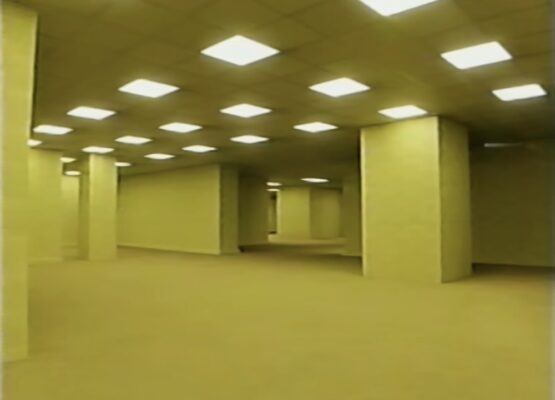
In this exploration of backrooms, our focus shifts from the theoretical framework discussed in previous texts to artistic practice, with the goal of observing how the liminal materializes in concrete images. Beyond its conceptual formulation, backrooms resonate in work by artists who have explored, with diverse artistic languages, architecture as a space of disorientation and alienation. Through these examples, we attempt not only to identify formal and conceptual affinities within backrooms but also the ways in which art anticipates perceptual and symbolic tensions.
Kane Parsons, The Backrooms
I couldn’t begin this exploration without first examining the work of Kane Parsons, a YouTube creator who in 2022, at the age of 17, began his filmography with the release of the short film The Backrooms (Found Footage). This horror film, along with others like it that followed and which form a series, established and solidified the foundations of the backroom genre. Although Parsons’ work isn’t part of the contemporary art world in the traditional sense, the film adaptation produced by A24, to be released in May 2026, aims for legitimization within the cultural industry.
The Backrooms (Found Footage) is set in a seemingly endless labyrinth of carpeted rooms and corridors, dominated by a palette of dirty yellowish tones and fluorescent lighting, clearly inspired by the first 4chan post about backrooms. The unsettling atmosphere of the setting comes from the degraded visual texture of the image, which mimics a VHS tape recording, even though almost everything is digitally created and not footage filmed in a real space.
The interior spaces in which the action unfolds are designed to disorient, they are environments without clear references where each room seems like a slight variation of the previous one. The protagonist enters this place accidentally, as if crossing a hidden threshold into another dimension and the action is reduced to the protagonist’s wandering through the space, initially slowly, then accelerated by their fear. Strange creatures appear throughout the wanderings. Barely shown, almost motionless, these apparitions present a disquieting Other rather than a direct threat. The protagonist, however, is never directly shown as the camera consistently adopts a subjective point of view that places the viewer in their position, thus reinforcing identification and the feeling of being trapped in an endless loop.
Parsons’ work reveals the extent to which the liminal has found fertile ground for its expansion into digital culture, both aesthetically and narratively. Through easily accessible technical resources and internet-based languages, his images manage to activate an experience of an alienation, marked by repetition, disorientation, and the loss of stable reference points, that immediately connects with contemporary sensibilities.
However, this exploration of the liminal is not limited to the digital realm or to emerging forms of visual production. On the contrary, it is part of a broader constellation of artistic practices that, from different disciplines and contexts, have addressed the condition of space as a threshold, as a place of transit, or as a device for perceptual destabilization that sees the uncanny as an emotional reaction.
Serafín Álvarez, Maze Walkthrough
The first work that came to mind when I began reading about backrooms was Maze Walkthrough by Serafín Álvarez, included in the exhibition Especies de espacios (Species of Spaces) curated by Frederic Montornés at the MACBA a few years ago.
Álvarez’s practice focuses on the exploration of the fictional landscape through digital imagery within a trilogy of projects in which the corridor emerges as a central figure. This seemingly secondary element in architecture is transformed through the artist’s work into a conceptual device for thinking about contemporary space. Álvarez himself attributes his interest in corridors to his reading of Deleuze and Guattari’s A Thousand Plateaus, and to his experience of spending endless hours in different airports during the production of a previous project when he began to focus on corridors, a usually over-looked architectural element, one which is neither an origin nor an end, only a transit, intermediary, a process.
Interested in science, physics, and speculative fiction, in 2012 Álvarez began a systematic compilation of images of corridors captured in science fiction films, giving rise to Case Study: Sci-Fi Corridor (2012-2015, a compulsive compilation of images that disregarded analysis and categorization, made public online through a Tumblr blog and the website scificorridorarchive.com. In the initial stage, the project only included still images but the artist soon felt the need to incorporate movement and began compiling video clips, aiming to link different spaces together in continuous montages.
His research culminated in Maze Walkthrough (2014), a desktop application that adopts the aesthetic and logic of three-dimensional video games. In it, the user experiences, in first person and at their leisure, their own journey through a labyrinth of interconnected corridors. As in many first-person perspective video games, the protagonist doesn’t appear on screen and the camera takes their place, thus fostering direct immersion. This is the most common approach in shooter, adventure, and horror games. In this case, however, it is something closer to a walking simulator, where the experience is based on movement and exploration of the environment. This walking simulator lacks combat mechanics, puzzles, or victory/defeat dynamics and the objective is not narrative. There are no rules, no purpose, only exploration, the aim being to get lost in the labyrinth, to keep moving.
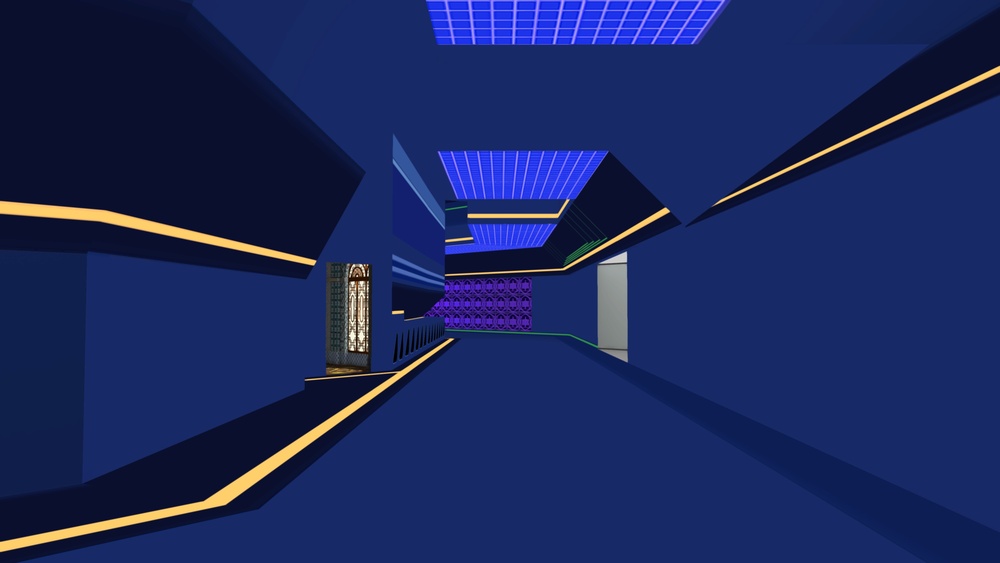
Serafín Álvarez, Maze Walkthrough, 2014 (screenshot). Courtesy of the artist
Unlike Parsons’ short films, Álvarez’s work doesn’t feature monsters nor is it a narrative of confinement in another dimension, and the Other remains completely absent. In the work, the passing through corridors, linked to one another in a loop, is enough to generate an experience of alienation that evokes a void more existential than narrative. One’s solitary, purposeless walk transforms this representation of architecture into a senseless drift, where space itself becomes the only experience.
Furthermore, and also unlike Parsons, Álvarez does not place particular emphasis on visual realism in this project. The images, generated using video game engines, maintain a certain degree of artificiality that is not concealed. The artist thus questions the idea that greater graphic or sound sophistication necessarily implies greater immersion. Instead, the work relies on the viewer’s voluntary suspension of disbelief, a mechanism by which the viewer temporarily accepts the rules of the fictional world and is guided by its internal coherence and their own emotional engagement.
The flip side of this experience would be the concept of the uncanny valley, which describes how digital or robotic representations generate greater repulsion in humans the closer they approach realism without fully achieving it. In contrast to this logic, Álvarez opts for an aesthetic that avoids such friction, positioning the work in an intermediate territory where artificiality is evident but not unsettling.
Finally, Maze Walkthrough can also be read as a paradigmatic case of the intersection between contemporary art and digital culture. The work establishes a bridge between the imagery of science fiction fandom, internet platforms, and the language of video games, integrating forms of production and circulation external to the traditional art system and reconfiguring them as artistic practice.
Gregor Schneider, Haus u r
Beyond the digital sphere, we can also find contemporary art practices that address architecture as a dark psychological landscape. This is the case with Gregor Schneider and his work Haus u r, paradigmatic of the relationship between the uncanny and architecture.
In 1985, at the age of 16 (one year younger than Parsons), Schneider began to build, destroy, and rebuild the interior of a house located at 12 Unterheydener Strasse in Rheydt, south of the German city of Mönchengladbach. This three-story building from the 1870s was left empty after the artist’s family moved out and it was given to him to use as a studio. This conventional space, which originally featured modest ornamentation and an almost symmetrical rectilinear composition, became the stage for a radical transformation that would extend until 2001. This was not a 15-year transformation but rather a series of incessant transformations that lent the work an organic and obsessive character.
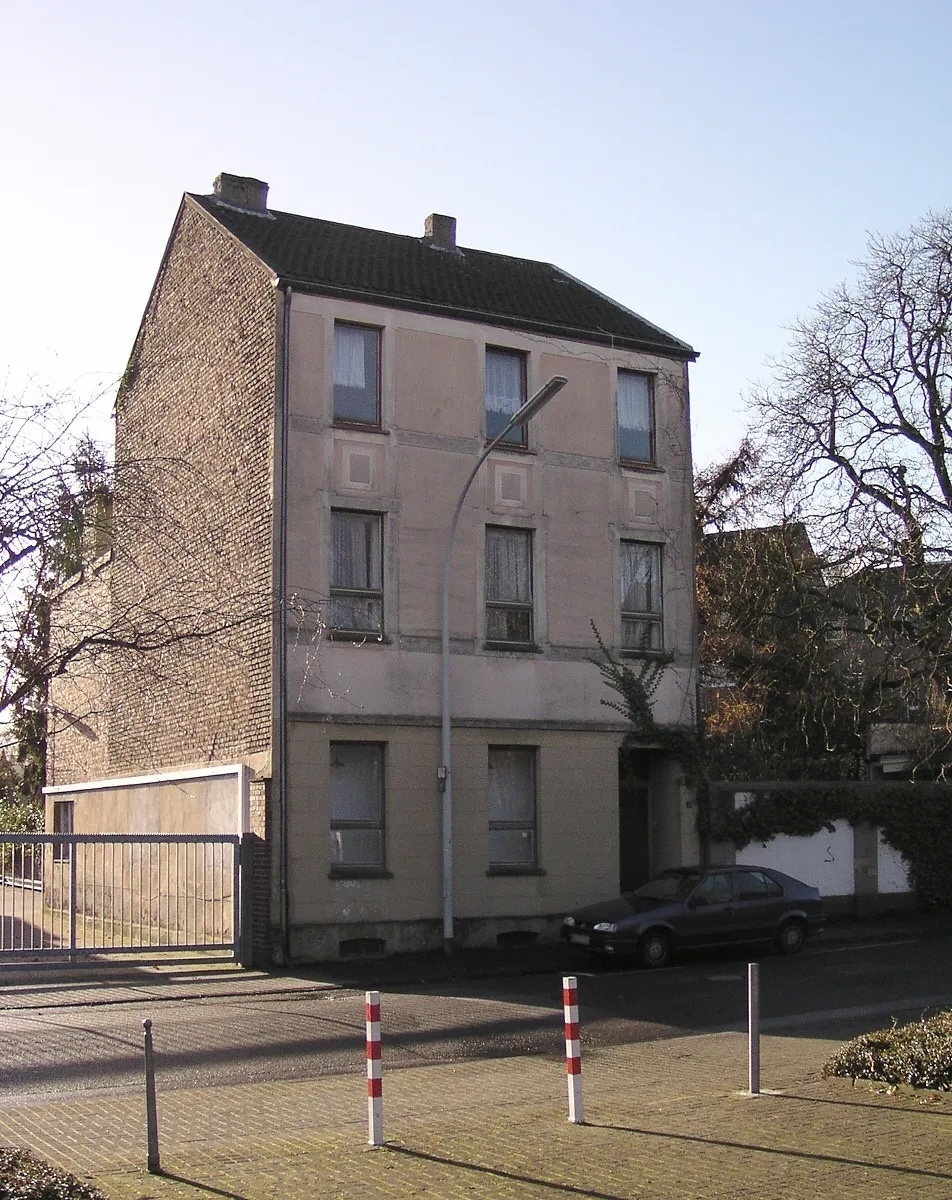
Gregor Schneider. Haus u.r. in Rheydt, Mönchengladbach
The interventions in the house were not designed to make it more habitable but rather sought to produce an ontological tension through duplication and dysfunctionality. In some cases, replicas were built within existing rooms, like matryoshka dolls, while in others, doors were relocated, walls were erected in front of windows, and access was created through an opening in a walk-in closet. These spaces tend to be austere, thus creating an atmosphere of decay and abandonment which alludes to a past full of life and fosters an experience of kenopsia, understood as the unease felt in the presence of a place that should be inhabited but which, nevertheless, appears deserted.
Initially, the house could only be visited by a few guests at a time, guided by Schneider himself. The work thus remained within the realm of the private, which increased its destabilizing effect on the viewer who, within the space, was unable to discern the original structure from its replica. It is a physical and psychologically claustrophobic experience. The facade of the house reveals nothing, while the interior, like the psyche, unveils the extent of its complexity.
The intermediate space between the external and internal layers of the house fosters the emergence of a structural network of hidden cavities that barely allow people to pass through. In some cases, these cavities house photographs of the artist’s ancestors. In the living room, a rotating floor system produces an imperceptible movement of people inside. The window, which from the inside appears to offer air and sunlight, is actually a blank space from the narrow inter-wall area in which a warm-light lamp and a small fan are located. The disorientation is heightened by blank windows and doors leading nowhere, highlighting the ghostly character of the place. Everything contributes to an experience of progressive disorientation in which domestic life has become unsettling.
Whether in its original location or in any of its subsequent itineraries since the 1990s, Haus u r imposes a route that visitors must follow, leaving the outside world behind. The walls are thick, and the doors, some armored, are installed in such a way that they close automatically behind each visitor. Thus, as visitors move through the labyrinthine succession of interconnected rooms and passageways, they experience an increasingly profound sense of interiority and a growing disconnection from the reality outside.
The biographical dimension permeates the work in a subtle yet decisive way. The family history is present through images and materials. In addition to photographs located in hidden spaces, the artist chose to add a double layer of lead insulation to the walls. This heavy, dense, and soft metal alludes to his family’s professional legacy spanning generations. Photographs and lead accumulate in the layers that make up the house’s walls, visible or concealed, linking architecture and memory.
As in Derrida’s différance, the identity of this house is destabilized from within as the space is defined as much by what it is as by what it is not, while its structure cannot be grasped through sight or experience. Furthermore, we once again encounter Freud’s concept of the uncanny, not only through the double and repetition but above all through the presence of hidden family memories in inaccessible spaces which, alluding to the unconscious, transform the house into a psychological structure marked by trauma.
Ultimately, Schneider’s work displaces the liminal into a profoundly internalized dimension, dealing not only with spaces of transit but with an entire building that embodies a state of mind, in which the threshold lies between consciousness and the repressed.
Kay Sage, No Passing
Finally, I would like to talk about an artist whose inclusion in this text may not seem obvious but one which I will firmly defend. Kay Sage, an artist whose work lies between modern and contemporary art, was part of the Surrealist group. Her paintings, however, are not typical of the movement due to their high degree of abstraction and a tendency to suppress organic figures. This abstraction, nonetheless, is full of recognizable architectural elements. Her mysterious and visionary character, which certifies her as a Surrealist, is particularly relevant in recognizing her as an undeniable reference point for art that uses architectural motifs to represent the uncanny.
Characteristic of Surrealism, Sage adopts symbolic representation as a key to understanding the workings of the human mind, but she then translates this into a radically personal aesthetic. In contrast to the fluid and biomorphic forms of many of her contemporaries, her language is cold, mechanical, precise, angular, and tense, in which sharp geometries predominate. The palette is reduced to muted blues and grays, silent tones that reinforce the feeling of emotional distance. Her meticulous technique becomes very stylized at times, intensifying the sharpness of these impossible constructions.
In her work, the refined forms, isolated in vast, empty spaces, generate an atmosphere of immobility, unease, and abandonment. The objects, superimposed without apparent logic, create a dislocated space akin to the fragmented structure of a dream. The architectural motifs, which permeate her entire oeuvre (even composing the faces in her portraits), never function as translatable symbols and their meanings remain ambiguous. Hers is a cryptic iconography, laden with a persistent melancholy, that expands the possibilities of surrealism by shifting the dreamlike toward an aesthetic of desolation, where architecture ceases to be a refuge and instead reflects a fractured subjectivity.
Among her work, a series of paintings created between 1944 and 1955 stand out, depicting complex architectural structures isolated in vast, uninhabited landscapes. Of these, I wish to focus particularly on No Passing, an arid landscape populated by windowless monoliths covered with rectangular panels and fabric. These fantastical constructions fade to the left, creating a sense of infinity. The meticulous brushwork connects with a surrealist realism that evokes a disquieting feeling of strangeness. The melancholic tone is reinforced by Sage’s characteristic muted color palette.
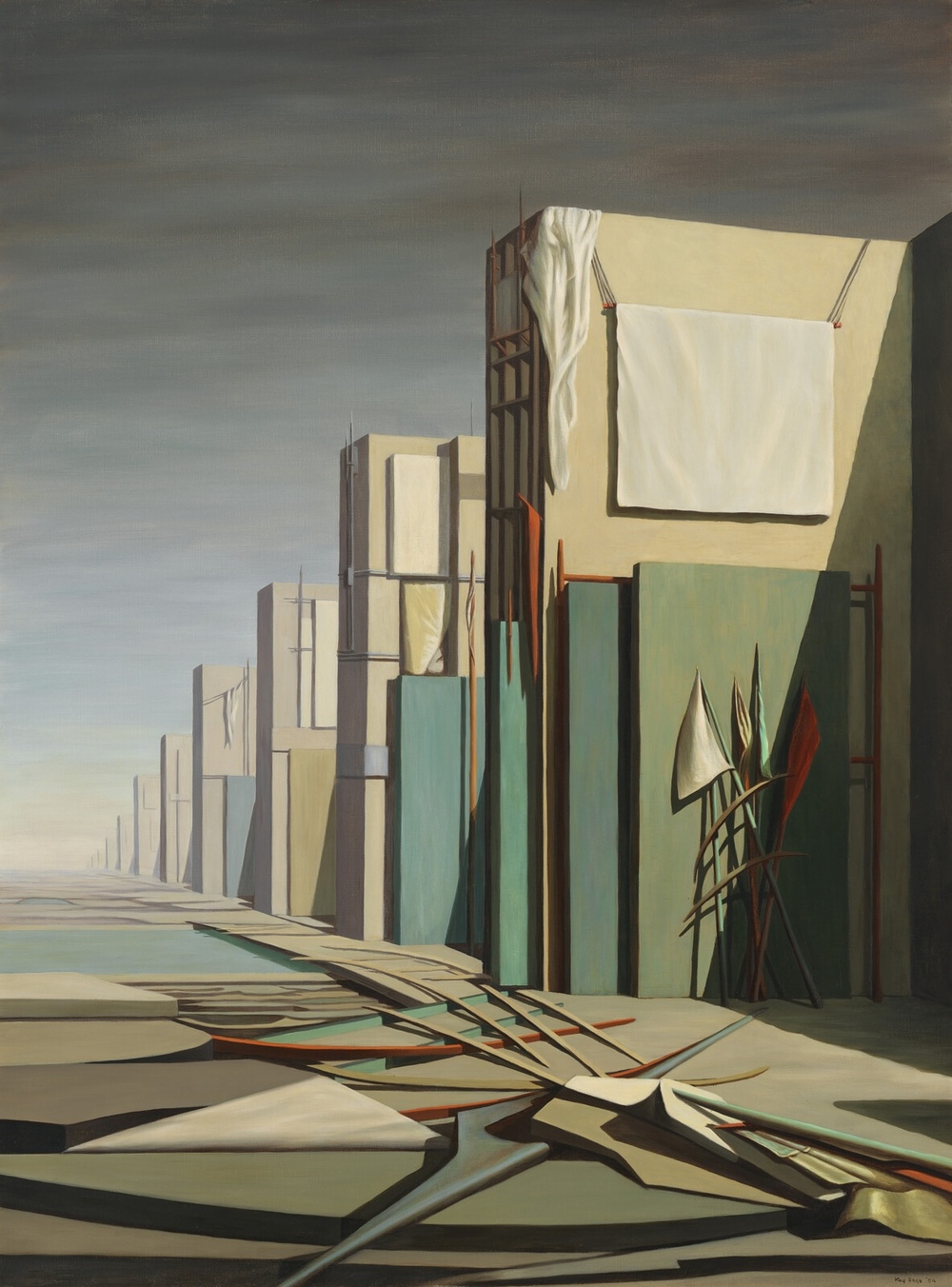
Kay Sage. No passing, 1954. Oil on linen, 130,2 x 96,5 cm. © 2026 Digital image Whitney Museum of American Art / Licensed by Scala
Planks and slats are arranged in geometric compositions dominated by diagonal and orthogonal lines. The stark shadows and forced perspective place the scene in a state of spatial ambiguity. Flag-like elements, leaning against the structures or scattered on the ground, suggest traces of activity abruptly interrupted. The scene is suspended in a disquieting human absence that again evokes the concept of kenopsia. However, if we consider that the constructive structures in her work represent the human psyche, we can also interpret this scene as a human chain marching into exile, a disinherited humanity wandering in a post-apocalyptic landscape.
The desolate landscapes and architecture as a metaphor for psychic emptiness also appear in her poetry. I include here her poem Tower, published in 1957, which echoes imagery similar to her paintings:
I have built a tower on despair,
You hear nothing in it, there is nothing to see;
There is no answer when, black on black,
I scream, I scream, in my ivory tower.
Viewing the desolate constructions in Kay Sage’s paintings, Gregor Schneider’s unsettling architectural installations, Serafín Álvarez’s inoperative digital landscapes, and Kane Parsons’ immense, menacing spaces, has led me to the same conclusion, namely, that space ceases to be a mere container and becomes a projection of mental states and invisible tensions that permeate contemporary experience.
I hereby conclude this first attempt to trace a genealogy of artistic practices that have explored architecture as a reflection of a conflicted psyche. Far from exhausting the subject, this exploration aims to open a field of interpretation from which to consider backrooms as the recent crystallization of a deeper, more collective unease, the suspicion that the space we inhabit no longer guides or sustains us but instead reflects back to us the fragmented image of our own wandering.
[Featured Image: Kane Parsons. The Backrooms (Found Footage), 2022]
Rosa A. Cruz is a Catalan-Andalusian art historian and cultural communicator. She has worked at the Museu d’Art Contemporani de Barcelona, at ADN Galeria and at the University of Barcelona, where she was part of the AGI Art, Globalization, Interculturality Research Group. She is particularly interested in questions about the double, psychology and biographical discourse. She is currently conducting research on the intersection between contemporary sexual and artistic practices.
Media Partners:







"A desk is a dangerous place from which to watch the world" (John Le Carré)