Search
To search for an exact match, type the word or phrase you want in quotation marks.
A*DESK has been offering since 2002 contents about criticism and contemporary art. A*DESK has become consolidated thanks to all those who have believed in the project, all those who have followed us, debating, participating and collaborating. Many people have collaborated with A*DESK, and continue to do so. Their efforts, knowledge and belief in the project are what make it grow internationally. At A*DESK we have also generated work for over one hundred professionals in culture, from small collaborations with reviews and classes, to more prolonged and intense collaborations.
At A*DESK we believe in the need for free and universal access to culture and knowledge. We want to carry on being independent, remaining open to more ideas and opinions. If you believe in A*DESK, we need your backing to be able to continue. You can now participate in the project by supporting it. You can choose how much you want to contribute to the project.
You can decide how much you want to bring to the project.
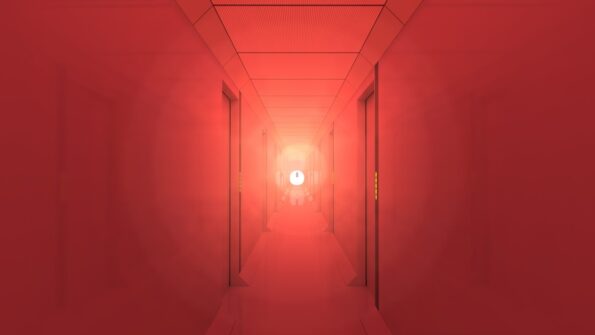
In recent years, backrooms have ceased to be mere digital fiction and have become a powerful metaphor for contemporary unease. These infinite, empty, and repetitive spaces condense the widely shared feeling of inhabiting a world in suspension. Far from being an isolated phenomenon, their aesthetic connects with a long tradition of thought about space and its influence on human behavior. In this context, the liminal emerges as a key tool for interpreting not only these images but also the cultural conditions that explain their transcendence.
Liminal is defined as synonymous with threshold, a space of transition between two states, whether physical or mental. Liminal space is situated between something that no longer is and something that is yet to come. Its transitory nature dilutes its meaning while simultaneously enhancing its transformative character.
The concept emerged in anthropology with the publication of Arnold Van Gennep’s The Rites of Passage (1909), in which he identified three phases: separation, marginalization (liminality), and integration. The first involves abandoning a previous state, the second is characterized by ambiguity, and the third entails integration into a new state. While the initial and final phases are clearly regulated, the liminal phase acts as a threshold without a fixed entity. In this sense, mourning can be understood as a quintessential liminal experience, in which the subject, affected by loss, traverses a zone of affective and symbolic indeterminacy. Liminality, therefore, is about questioning and is thus imbued with enormous transformative potential.
Later, Victor Turner expanded this notion by describing it as a suspension of the norm within social structures. This concept thus extends beyond the rite of passage, influencing cultural processes such as the formation of identities of both individuals and communities. The liminal is configured as a space where hierarchies become blurred and categories lose their stability. This suspension of the norm gives way to the emergence of hybrid, even grotesque, forms, in which disorder not only challenges the established order but also enables new configurations of meaning and identity. This can be seen, for example, in carnivals, where costumed participants set aside their individual identities to integrate into an anarchic community.
Over time, the concept was taken up by disciplines such as psychology and architecture which used it to describe spaces of transition, whether physical or metaphysical, passages, interstices, or moments of change in which one does not fully belong to either a past or a future state. In this broader perspective, even certain historical periods can be considered liminal. Such is the case of the COVID-19 pandemic, which established a collective experience of suspension, uncertainty, and a redefinition of social dynamics, with societies hovering over a prolonged threshold between what had been and what was yet to come (although ultimately that future was not so different from what came before).
The liminal has permeated contemporary cultural in all its facets. Works of art, music, film, and literature are now interpreted through their relationship to the liminal as an aesthetic and emotional category. However, it is perhaps in architecture where this condition becomes most evident and tangible. Liminal spaces materialize as places of passage that are not conceived to be inhabited in the strict sense but rather to be traversed. Hallways, lobbies, and stations configure settings that we inhabit only in the middle of a longer journey. They are places where we feel we have been at some point but which are hardly memorable or distinguishable from places that fulfill the same functions in other parts of the world.
Before the turn of the last century, several approaches to architecture emerged from the philosophical perspective of space. In 1992, anthropologist Marc Augé coined the term “non-place” to refer to spaces that people occupy transiently and whose identity is defined by their functionality. In these spaces, human activity is heavily conditioned by instructions for use, signage, and protocols. In non-places, including highways, shopping malls, and airports, the individual becomes a user or consumer.
Meanwhile, in 1995, architect and philosopher Ignasi de Solà-Morales introduced the concept of terrain vague to define abandoned and unproductive urban spaces located on the peripheries. Unlike non-places, the terrain vague is not over-regulated by a function but rather defined precisely by its indeterminacy. These spaces are voids within the logic of productivism, open to possibility and informal appropriation but also marked by marginalization and abandonment.
Finally, in 2002, architect Rem Koolhaas published the essay Junkspace to critique the abuses of consumerism in architecture. Hyperabundance, uniformity, and depoliticization, according to Koolhaas, confirm the failure of early 20th-century utopias. Junkspace has no limits as there is no inside or outside, no beginning or end, just an endless flow of interconnected zones that keeps the population controlled within the system. It is an infinite and claustrophobic architecture, replete with false ceilings, air conditioning, escalators, and endless corridors.
Taken together, junkspace, non-places, and terrain vague constitute paradigmatic spatial typologies of contemporary architecture. Through their diversity, these concepts have contributed to shaping the aesthetics of backrooms and constructing a theoretical framework from which to understand the liminal, revealing different ways in which contemporary space is configured as a threshold, a transition, or a suspension.
In the next article, I will propose a journey through work by artists who, from different languages and contexts, have managed to materialize this condition of the threshold. If the concepts of non-places, terrain vague, and junkspace allow us to understand how contemporary life has produced spaces of transit and indeterminacy, it is in artistic practice that these qualities acquire an embodied, unsettling dimension. In this shift from theory to image, the liminal ceases to be merely an analytical category and becomes an uncomfortable experience.
[Featured Image: Serafín Álvarez, Maze Walkthrough, 2014 (screenshot). Courtesy of the artist]
Rosa A. Cruz is a Catalan-Andalusian art historian and cultural communicator. She has worked at the Museu d’Art Contemporani de Barcelona, at ADN Galeria and at the University of Barcelona, where she was part of the AGI Art, Globalization, Interculturality Research Group. She is particularly interested in questions about the double, psychology and biographical discourse. She is currently conducting research on the intersection between contemporary sexual and artistic practices.
Media Partners:








"A desk is a dangerous place from which to watch the world" (John Le Carré)