Search
To search for an exact match, type the word or phrase you want in quotation marks.
A*DESK has been offering since 2002 contents about criticism and contemporary art. A*DESK has become consolidated thanks to all those who have believed in the project, all those who have followed us, debating, participating and collaborating. Many people have collaborated with A*DESK, and continue to do so. Their efforts, knowledge and belief in the project are what make it grow internationally. At A*DESK we have also generated work for over one hundred professionals in culture, from small collaborations with reviews and classes, to more prolonged and intense collaborations.
At A*DESK we believe in the need for free and universal access to culture and knowledge. We want to carry on being independent, remaining open to more ideas and opinions. If you believe in A*DESK, we need your backing to be able to continue. You can now participate in the project by supporting it. You can choose how much you want to contribute to the project.
You can decide how much you want to bring to the project.
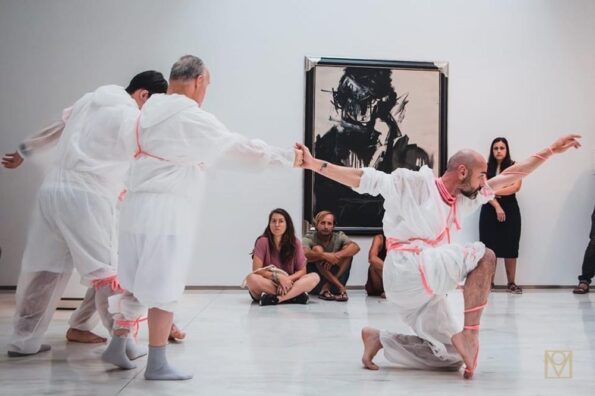
There are bodies that are functional and there are bodies that are disruptive. The former sustain the invisible choreography of the everyday by producing, responding, adapting, fitting in. The latter, on the other hand, introduce a friction that can’t always be identified. This is not just a question of difference or diversity but of not fitting in. Something about them doesn’t quite conform to the logic that organizes space, time, and perception. In the context of contemporary performance practices, these bodies don’t appear as subjects to be integrated but rather as forces that disrupt the very idea of the stage. It’s not about who can be there but instead under what conditions a body becomes legible, visible, or even conceivable.
Many of the practices that are grouped today under the term “inclusion” continue to operate within a framework that is rarely questioned. They expand the boundaries of the stage so that more bodies can enter but they don’t alter the conditions that define what it means to be on stage. New presences are incorporated but the criteria for legibility remain intact, that is, clarity, coherence, control, and responsiveness. In this sense, inclusion functions as an adjustment that doesn’t transform the structure but only broadens it.
However, there are performances that don’t operate like this, that don’t seek to make certain bodies function within the scene but rather let their presence challenge the scene itself. Instead of correcting the imbalance, they maintain it. Instead of redirecting the gesture, they listen to it. In this shift, what emerges is not a more open scene but a different scene altogether.
The stage, far from being a neutral space, is permeated by a logic that transcends art, a logic that decides which bodies are effective, which timings are acceptable, and which forms of attention count as presence. This is not just an aesthetic question but rather an economy of the body, one that clearly produces meaning, sustains a recognizable action, responds within a predictable framework. This invisible choreography doesn’t belong exclusively to the theatrical realm but is, in fact, the same one that governs everyday life, and the stage only amplifies it. Within this framework, the value of a body is measured (more or less explicitly) by its capacity to respond, to sustain, to be available for someone’s interpretation.
When a body doesn’t respond to this logic it doesn’t appear as an alternative but rather as an interruption. It can’t be measured against the norm, it simply doesn’t conform. It repeats when variation is expected, it stops when continuity is demanded, it displaces time when everything seems heading toward an outcome. I recall a situation in which, in the middle of a group sequence, a person remained completely motionless. There was no visible error or explicit disruption, they simply didn’t enter into action. While the others moved forward, their body maintained a stillness that didn’t respond to any recognizable instruction. The scene continued but something ceased to comply.
From the outside, the tendency is to integrate, to correct, to make each presence join the general flow, but by not intervening, that stillness began to reorganize the perception of the whole. It was no longer about a body that wasn’t performing but rather a body that shifted the meaning of what was happening. Attention fractured, the rhythm became tense, the scene ceased to be homogeneous.
From a perspective steeped in correction, that body didn’t work. If the intervention is suspended, however, if the need for adjustment stops, another organization and another form of presence begin to emerge. At this point, the question ceases to be what is happening to that body and shifts to the question about what kind of scene needs everything to be legible in order to sustain itself? What these bodies bring into play is not a lack but a limit, for they point to the extent to which we have naturalized a single way of being, moving, and appearing. In doing so, they open up a gap in the relationship between body and value.
The problem isn’t just theatrical. The equivalence between a valid body and a productive body permeates much of contemporary social organization. A body that doesn’t respond, that doesn’t update itself, that doesn’t adapt fluidly, is easily excluded from the frameworks of recognition. In this context, performance practices that embrace disruption are not simply representing another reality, they are intervening in it. They aren’t adding diversity to an existing structure but rather deactivating, even if only momentarily, the logic that sustains it.
This is why, perhaps, these kinds of bodies are unsettling, not because they are radically different but because they make visible what normality needs to conceal, namely, that the way we organize movement, time, and attention is not a natural thing but a constructed one and one that is, therefore, transformable.
These bodies aren’t there to occupy a place on the stage, they come to alter the conditions that make it possible.
Image: “Sinapsis. Inclusive Dance and Performing Arts”, a project selected by Art for Change by “la Caixa”. Museum of Contemporary Art of Alicante. Photography: @oncemusas.
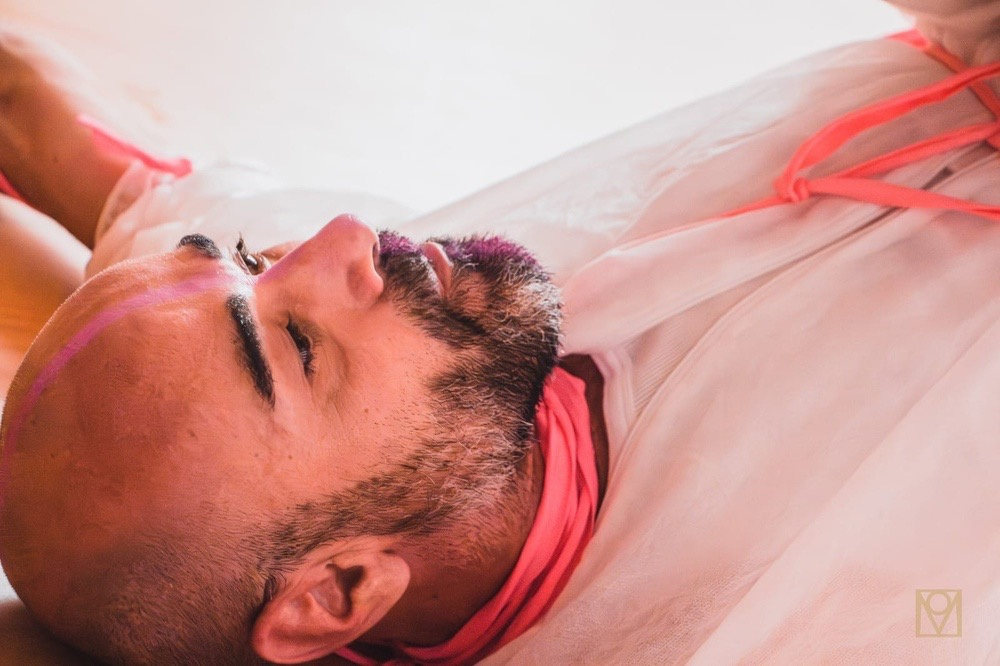
Luis Martínez López is a stage creator, teacher, and researcher in performance practices and inclusion. His work lies at the intersection of art, pedagogy, and embodied thought, exploring the stage as a space for research where the body does not represent, but rather produces knowledge. He develops stage and educational projects in diverse contexts, especially those related to functional diversity, where he investigates other forms of presence, relationship, and creation. He is the author of several publications on the body, stage, and performance research, and the creator of the podcast *Entre Bambalinas y Otras Herejías* (Behind the Scenes and Other Heresies), a narrative project about figures who transcended the norms of the stage. He currently works at the Infanta Leonor Center (Alicante), a center specializing in people with autism spectrum disorder.
Media Partners:









"A desk is a dangerous place from which to watch the world" (John Le Carré)