Search
To search for an exact match, type the word or phrase you want in quotation marks.
A*DESK has been offering since 2002 contents about criticism and contemporary art. A*DESK has become consolidated thanks to all those who have believed in the project, all those who have followed us, debating, participating and collaborating. Many people have collaborated with A*DESK, and continue to do so. Their efforts, knowledge and belief in the project are what make it grow internationally. At A*DESK we have also generated work for over one hundred professionals in culture, from small collaborations with reviews and classes, to more prolonged and intense collaborations.
At A*DESK we believe in the need for free and universal access to culture and knowledge. We want to carry on being independent, remaining open to more ideas and opinions. If you believe in A*DESK, we need your backing to be able to continue. You can now participate in the project by supporting it. You can choose how much you want to contribute to the project.
You can decide how much you want to bring to the project.
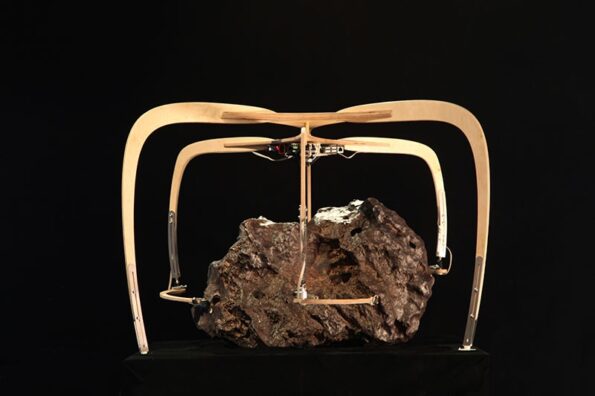
As July’s editor-in-residence for A*DESK, I propose to focus on the intersection between two opposing gestures, that is, the enthusiastic celebration of innovation and the denunciation of technological extractivism, without relating one to the other. The questions guiding this issue are something along the lines of: What are the ways of working (with) machines that exist in Latin America, and from what memories and with what sounds?
The title embraces multiplicity and is beyond any declaration of identity or regional stereotypes. The texts gathered here explore different approaches, media, time periods, and geographical areas, although they are united by a common conviction that, in Latin America, technology can be more than an imported phenomenon and a promise for the future. Technology is a material and symbolic battleground, and other countries have nothing over us.
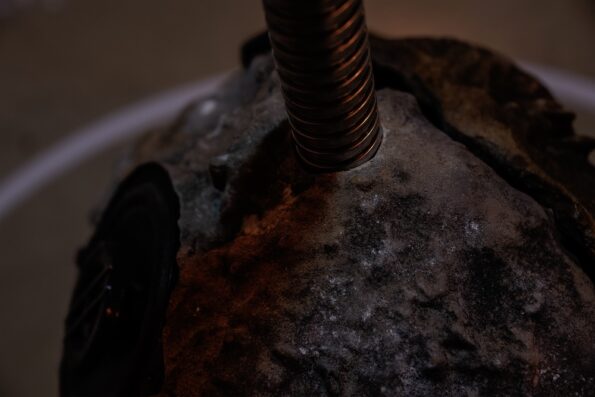
Oscar Santillán, ANTHEM, courtesy of the artist
The path unfolds organically, emerging from an archaeological perspective on Latin America’s digital prehistory, then continues with speculative curating as a geological and spectral temporality, moving toward the stubborn materiality of malfunctioning machines, and concluding by articulating conceptual tools for further reflection on technologies of listening and world-building.
We begin with Doreen Ríos, who traces an archaeology of net art in Mexico from the 1990s to the 2010s, rescuing foundational experiences and digital activism from an era when a truly distributed connection gave rise to a dream of creating a genealogy of artistic communities which understood the internet as a territory for political and poetic experimentation. Juliana Gontijo follows with a text that invites us to consider curating as a technology of temporal interference. Between oxidation, faults, and telluric communication, she proposes a radical gesture, that is, to reopen buried temporalities rather than offering redemptive futures, a lesson from the Global South to remind us what an exhibition can achieve. In turn, Jazmín Adler explores a body of work depicting failed and inefficient machines that crash, get tired, and fight. Her writing inhabits errors as operations with a profoundly personal meaning, and through her reference to counter-hegemonic machines, she links failure with disobedience. I conclude with my own text, in which I propose the notion of a “scale interface” to consider how sensors connect the local with the planetary, without resolving any of this tension. By revisiting contemporary methods of sensor design, this text attempts to show that, in our countries, sensitivity opens pathways to activate frictions and transform noise into shared space.
This issue, as a whole, aspires to be a constellation of situated questions, hoping to provoke, through texts, a certain interference or noise in which one only needs the presence of a signal.
[Featured Image: Marcela Armas, Sideral. Courtesy of the artist]
Hernán Borisonik holds a PhD in Social Sciences from the University of Buenos Aires and is a researcher at Conicet (National Council of Experts). He is an adjunct professor at the School of Humanities at the National University of San Martín, where he directs the Center for Science and Thought. He coordinates various projects in philosophy and political theory that explore issues related to money, sacredness, politics, and the arts. He occasionally curates, performs, and art criticism. He won second place in the Argentine National Prize for Philosophical Essays in 2020. He has edited several academic and popular volumes and published the books “Dinero Sagrado” [Sacred Money], “Soporte” [Support], and “Persistencia de la pregunta por el arte” [Persistence of the Question of Art], among others.
Media Partners:






"A desk is a dangerous place from which to watch the world" (John Le Carré)